Ramana Maharishi: The Sage of Arunachala

Ramana Maharishi – the sage of Arunachala

Ramana Maharishi: The Sage of Arunachala

Ramana Maharishi, born Venkataraman Iyer on December 30, 1879, in the small village of Tiruchuzhi in Tamil Nadu, is one of the most respected spiritual figures in modern India. His teachings and life stories inspire millions around the world, crossing spiritual and cultural boundaries. Renowned for his deep spiritual insights and simple yet powerful teachings, Ramana Maharishi is often seen as the embodiment of Advaita Vedanta, a non-dualistic school of Hindu philosophy.

Early Life and Spiritual Awakening

Venkataraman’s youth was fairly unremarkable. Born into a middle-class Brahmin family, he showed no remarkable spiritual inclinations during his childhood. He attended school like other children and was known for his physical strength and intelligence. At the age of sixteen, his life took a significant turn when he experienced a profound spiritual awakening.

In 1896, while alone in his uncle’s house in Madurai, Venkataraman was suddenly overcome by an intense fear of death. Instead of succumbing to panic, he decided to confront this fear immediately. He lay down and enacted a dramatic simulation of his own death. He observed the process dispassionately, asking himself what dies and concluding that though the body dies, the Self remains. This profound awareness of the Self, or the Atman, as distinct from the body, brought about his awakening.

This transformative experience was so powerful that it led him to leave his family. Without telling anyone, he set off on a journey to Arunachala, a sacred hill in Tiruvannamalai, which he instinctively felt was his spiritual home.

Life at Arunachala

Upon arriving at Arunachala, Venkataraman adopted the lifestyle of a renunciate, soon becoming known as Ramana Maharishi. For the first few years, he engaged in silent meditation, finding deep joy in the experience of the Self. He often lived in caves and temples around the hill. As he radiated spiritual energy, he began to attract a steady stream of seekers and devotees, all drawn to the peace and wisdom he exuded.

Though he initially maintained silence, Ramana eventually began to teach in response to the needs of those who sought his guidance. His teachings were direct and simple, emphasizing self-inquiry as the most direct route to spiritual realization. He often encouraged his followers to ask themselves the question "Who am I?" and to focus on the source of the "I-thought," guiding them toward the realization of their true nature.

Teachings

Ramana Maharishi's teachings are based on the philosophy of Advaita Vedanta. He emphasized that the true Self, or natural consciousness, is the most fundamental reality, while the sense of individuality or ego is merely an illusion. According to Ramana, liberation (moksha) is achieved not by gaining new knowledge, but by shedding the ignorance that hides our true nature. His method of self-inquiry involves turning the mind inward and questioning the origin of the "I" concept until one goes beyond the ego and realizes the Self. Although this practice may seem simple, it is a profound and direct path to self-awareness. Ramana also taught the importance of surrendering to a higher power. He suggested that for those who find self-inquiry too challenging, it may be beneficial to relinquish their personal will to the divine.

Ramana's teachings are remarkable for their clarity and practicality. He moved away from complex rituals and esoteric practices, instead focusing on the direct experience of the Self. He believed that self-inquiry was not just for a select few, but accessible to anyone willing to earnestly pursue it.

Influence and Legacy

Ramana Maharishi’s influence extends far beyond the confines of conventional Hinduism. His teachings resonate with spiritual seekers across various spiritual and cultural backgrounds. The ashram established around him in Tiruvannamalai, Sri Ramanasramam, remains a beacon for spiritual seekers from around the world, offering a space for meditation, reflection, and immersion in his teachings.

Prominent figures from various walks of life, including philosophers, writers, and spiritual leaders, have spoken of Ramana's profound impact on their spiritual journeys. For instance, Carl Jung, the renowned psychologist, recognized the importance of Ramana's insight in the context of contemporary psychology. Paul Brunton, a British journalist and writer, helped introduce Ramana's teachings to the Western world through his writings.

Despite his worldwide influence, Ramana Maharishi remained humble and simple throughout his life. He lived modestly, displaying deep compassion and empathy for all who came to him. His daily routine was marked by simplicity, humility, and a profound connection to the divine.

Writings and Dialogues

Ramana Maharishi’s teachings are captured in various dialogues and writings, primarily recorded by his disciples. His key work, "Who Am I?", is a straightforward guide to the practice of self-inquiry and is essential to his teachings. Other important collections, such as "Talks with Sri Ramana Maharishi" and "Be as You Are," present his teachings in an accessible and practical format.

In these dialogues, Ramana often used metaphors and analogies to explain complex spiritual truths. One well-known analogy compares the self to a movie screen. Just as the screen remains unchanged regardless of the film being shown, the Self also remains constant and unaffected by the experiences of the body and mind.

Ramana Maharishi, originally named Venkataraman Iyer, earned the title of "maharishi" for his extraordinary spiritual wisdom and enlightenment. In Hindu tradition, a "maharishi" is a sage who has attained a high level of spiritual understanding, and Ramana Maharishi exemplified this through his life and teachings. His profound insights into the nature of existence came from his direct experience of the ultimate truth, known as Self-realization or God-realization, transcending the ego and embodying spiritual wisdom. He lived a life of moral purity, reflecting virtues such as compassion, non-violence, truthfulness, and selflessness. Detached from material possessions and worldly concerns, Ramana Maharishi focused solely on spiritual knowledge and liberation. His spiritual guidance and teachings have impacted countless individuals on their spiritual journeys. Although some believed he possessed extraordinary spiritual powers, his true greatness lay in his deep realization rather than any display of these abilities.

Central to his teachings were the concepts of self-inquiry and surrender. Self-inquiry involves quieting the mind and asking introspective questions like, "To whom does this thought arise?" or "Who am I?" This practice leads to deeper understanding and inner peace. Surrender, on the other hand, is about recognizing the limitations of human existence and letting go of desires, actions, and emotions to a higher power. Together, these methods foster spiritual growth and provide a clear pathway to self-realization.

His Final Years

In his later years, Ramana Maharishi remained at Arunachala, attracting a large following from across the world. Even after being diagnosed with cancer in 1949, he continued to guide his devotees with calm composure, frequently emphasizing that the body is merely a vessel, while the true Self exists beyond birth and death. Ramana Maharishi passed away on April 14, 1950, entering mahasamadhi, a state of conscious departure from the physical body. His passing left a profound sense of loss among his followers, but his teachings and spiritual presence continue to inspire millions.

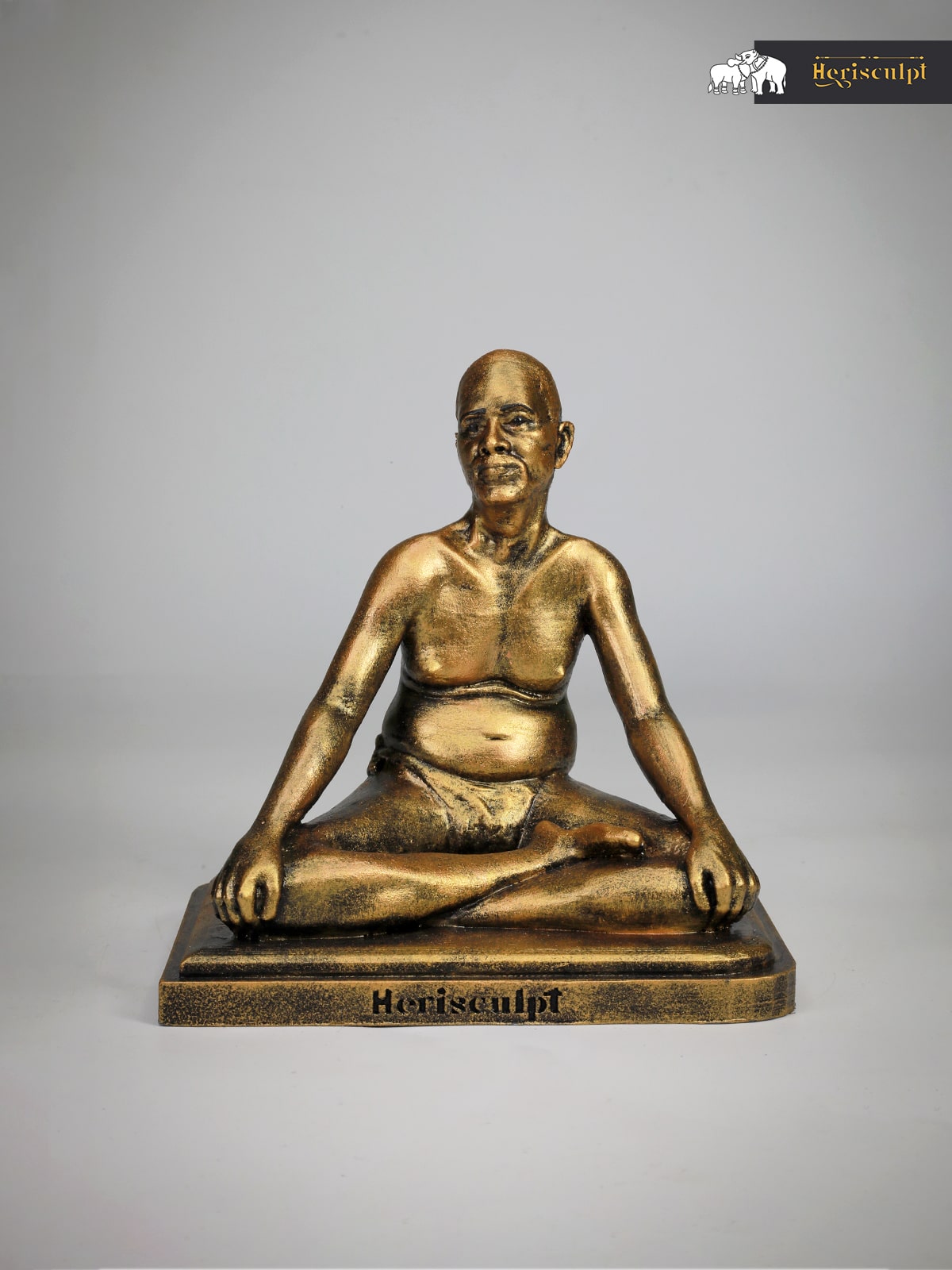
As the sage of Arunachala, Ramana Maharishi’s teachings on self-inquiry and the realization of the Self provide timeless guidance for those seeking ultimate truth. His life is a testament to the enduring power of inner awareness and the profound peace of the true Self. A Ramana Maharishi statue often serves as a visual reminder of his teachings, evoking the calm, peace, and wisdom that he embodied. Through his legacy, Ramana Maharishi has left an indelible mark on modern spirituality, helping countless individuals in their journey toward self-realization.

— Team Herisculpt

See the sculpture up close and choose your finish.

View the Ramana Maharshi sculpture
Stories in SculptureArunachala

Ramana Maharishi: The Sage of Arunachala

19 Sep 2024 6 min read

Ramana Maharishi, born Venkataraman Iyer in 1879 in Tiruchuzhi, is one of the most respected spiritual figures of modern India. His simple teaching of self-inquiry, “Who am I?”, continues to inspire seekers worldwide.

Ramana Maharishi – the sage of Arunachala

Ramana Maharishi: The Sage of Arunachala

Ramana Maharishi, born Venkataraman Iyer on December 30, 1879, in the small village of Tiruchuzhi in Tamil Nadu, is one of the most respected spiritual figures in modern India. His teachings and life stories inspire millions around the world, crossing spiritual and cultural boundaries. Renowned for his deep spiritual insights and simple yet powerful teachings, Ramana Maharishi is often seen as the embodiment of Advaita Vedanta, a non-dualistic school of Hindu philosophy.

Early Life and Spiritual Awakening

Venkataraman’s youth was fairly unremarkable. Born into a middle-class Brahmin family, he showed no remarkable spiritual inclinations during his childhood. He attended school like other children and was known for his physical strength and intelligence. At the age of sixteen, his life took a significant turn when he experienced a profound spiritual awakening.

In 1896, while alone in his uncle’s house in Madurai, Venkataraman was suddenly overcome by an intense fear of death. Instead of succumbing to panic, he decided to confront this fear immediately. He lay down and enacted a dramatic simulation of his own death. He observed the process dispassionately, asking himself what dies and concluding that though the body dies, the Self remains. This profound awareness of the Self, or the Atman, as distinct from the body, brought about his awakening.

This transformative experience was so powerful that it led him to leave his family. Without telling anyone, he set off on a journey to Arunachala, a sacred hill in Tiruvannamalai, which he instinctively felt was his spiritual home.

Life at Arunachala

Upon arriving at Arunachala, Venkataraman adopted the lifestyle of a renunciate, soon becoming known as Ramana Maharishi. For the first few years, he engaged in silent meditation, finding deep joy in the experience of the Self. He often lived in caves and temples around the hill. As he radiated spiritual energy, he began to attract a steady stream of seekers and devotees, all drawn to the peace and wisdom he exuded.

Though he initially maintained silence, Ramana eventually began to teach in response to the needs of those who sought his guidance. His teachings were direct and simple, emphasizing self-inquiry as the most direct route to spiritual realization. He often encouraged his followers to ask themselves the question "Who am I?" and to focus on the source of the "I-thought," guiding them toward the realization of their true nature.

Teachings

Ramana Maharishi's teachings are based on the philosophy of Advaita Vedanta. He emphasized that the true Self, or natural consciousness, is the most fundamental reality, while the sense of individuality or ego is merely an illusion. According to Ramana, liberation (moksha) is achieved not by gaining new knowledge, but by shedding the ignorance that hides our true nature. His method of self-inquiry involves turning the mind inward and questioning the origin of the "I" concept until one goes beyond the ego and realizes the Self. Although this practice may seem simple, it is a profound and direct path to self-awareness. Ramana also taught the importance of surrendering to a higher power. He suggested that for those who find self-inquiry too challenging, it may be beneficial to relinquish their personal will to the divine.

Ramana's teachings are remarkable for their clarity and practicality. He moved away from complex rituals and esoteric practices, instead focusing on the direct experience of the Self. He believed that self-inquiry was not just for a select few, but accessible to anyone willing to earnestly pursue it.

Influence and Legacy

Ramana Maharishi’s influence extends far beyond the confines of conventional Hinduism. His teachings resonate with spiritual seekers across various spiritual and cultural backgrounds. The ashram established around him in Tiruvannamalai, Sri Ramanasramam, remains a beacon for spiritual seekers from around the world, offering a space for meditation, reflection, and immersion in his teachings.

Prominent figures from various walks of life, including philosophers, writers, and spiritual leaders, have spoken of Ramana's profound impact on their spiritual journeys. For instance, Carl Jung, the renowned psychologist, recognized the importance of Ramana's insight in the context of contemporary psychology. Paul Brunton, a British journalist and writer, helped introduce Ramana's teachings to the Western world through his writings.

Despite his worldwide influence, Ramana Maharishi remained humble and simple throughout his life. He lived modestly, displaying deep compassion and empathy for all who came to him. His daily routine was marked by simplicity, humility, and a profound connection to the divine.

Writings and Dialogues

Ramana Maharishi’s teachings are captured in various dialogues and writings, primarily recorded by his disciples. His key work, "Who Am I?", is a straightforward guide to the practice of self-inquiry and is essential to his teachings. Other important collections, such as "Talks with Sri Ramana Maharishi" and "Be as You Are," present his teachings in an accessible and practical format.

In these dialogues, Ramana often used metaphors and analogies to explain complex spiritual truths. One well-known analogy compares the self to a movie screen. Just as the screen remains unchanged regardless of the film being shown, the Self also remains constant and unaffected by the experiences of the body and mind.

Ramana Maharishi, originally named Venkataraman Iyer, earned the title of "maharishi" for his extraordinary spiritual wisdom and enlightenment. In Hindu tradition, a "maharishi" is a sage who has attained a high level of spiritual understanding, and Ramana Maharishi exemplified this through his life and teachings. His profound insights into the nature of existence came from his direct experience of the ultimate truth, known as Self-realization or God-realization, transcending the ego and embodying spiritual wisdom. He lived a life of moral purity, reflecting virtues such as compassion, non-violence, truthfulness, and selflessness. Detached from material possessions and worldly concerns, Ramana Maharishi focused solely on spiritual knowledge and liberation. His spiritual guidance and teachings have impacted countless individuals on their spiritual journeys. Although some believed he possessed extraordinary spiritual powers, his true greatness lay in his deep realization rather than any display of these abilities.

Central to his teachings were the concepts of self-inquiry and surrender. Self-inquiry involves quieting the mind and asking introspective questions like, "To whom does this thought arise?" or "Who am I?" This practice leads to deeper understanding and inner peace. Surrender, on the other hand, is about recognizing the limitations of human existence and letting go of desires, actions, and emotions to a higher power. Together, these methods foster spiritual growth and provide a clear pathway to self-realization.

His Final Years

In his later years, Ramana Maharishi remained at Arunachala, attracting a large following from across the world. Even after being diagnosed with cancer in 1949, he continued to guide his devotees with calm composure, frequently emphasizing that the body is merely a vessel, while the true Self exists beyond birth and death. Ramana Maharishi passed away on April 14, 1950, entering mahasamadhi, a state of conscious departure from the physical body. His passing left a profound sense of loss among his followers, but his teachings and spiritual presence continue to inspire millions.

As the sage of Arunachala, Ramana Maharishi’s teachings on self-inquiry and the realization of the Self provide timeless guidance for those seeking ultimate truth. His life is a testament to the enduring power of inner awareness and the profound peace of the true Self. A Ramana Maharishi statue often serves as a visual reminder of his teachings, evoking the calm, peace, and wisdom that he embodied. Through his legacy, Ramana Maharishi has left an indelible mark on modern spirituality, helping countless individuals in their journey toward self-realization.

— Team Herisculpt

See the sculpture up close and choose your finish.

View the Ramana Maharshi sculpture

Bring this story home

Sculptures from this tradition

Shop all →

Researched from temple bronzes and sculpted in 3D in our Thanjavur workshop.

Conversing Hanuman resin statue, a Chola-style standing Hanuman with hand raised in conversation. Handcrafted heritage decor by Herisculpt for pooja rooms, living spaces, offices and thoughtful gifting.

Conversing Hanuman Sculpture

Rs. 1,750
Kodiyakarai Chola Lighthouse resin miniature, a miniature of the ruined Chola-era lighthouse at Kodiyakarai. Handcrafted heritage decor by Herisculpt for pooja rooms, living spaces, offices and thoughtful gifting.

Kodiyakarai Chola Lighthouse Miniature

Rs. 999
Chandikeshwarar Gangaikondacholapuram resin sculpture, Shiva and Parvati blessing the devotee Chandikeshwarar, inspired by the Gangaikondacholapuram panel. Handcrafted heritage decor by Herisculpt for pooja rooms, living spaces, offices and thoughtful gifting.

Chandikeshwarar Gangaikondacholapuram Sculpture

Rs. 4,999
Tribhanga Parvathi resin statue, a Chola-style Parvathi standing in the graceful tribhanga pose. Handcrafted heritage decor by Herisculpt for pooja rooms, living spaces, offices and thoughtful gifting.

Tribhanga Parvathi Sculpture

Rs. 2,199

Heritage was never meant to stay behind glass. It belongs on a shelf, in a gift, and in the stories people tell.

For the collector

Pair it with a statement piece

Shop premium →
A standing statue of Raja Alangaram Murugan in royal attire, with a fan-crested turban, embroidered coat, layered necklaces and long garlands, holding the vel beside a perched rooster, on a pierced floral pedestal against a cream background. Text at the top reads 'Raja Alangaram Murugan'.

Raja Alangaram Murugan — Standing Royal Murugan Sculpture

Rs. 3,999
A seated statue of Sri Mahakali, the fierce Goddess Kali, with flame-like crown and skull garland, raising a curved sword and holding a round shield, cup and severed head above a crouching demon, on a cream background. Text at the top reads 'Sri Mahakali — The Eternal Destroyer of Darkness'.

Sri Mahakali — Seated Goddess Kali Sculpture

Rs. 6,500
Seshadri Swamigal resin statue, the saint of Tiruvannamalai seated on a stone pedestal, chin resting on his hand in quiet contemplation. Handcrafted heritage decor by Herisculpt for pooja rooms, living spaces, offices and thoughtful gifting.

Seshadri Swamigal Sculpture

Rs. 1,499
Nammazhvar resin statue, the organic farming pioneer seated on a rock with clasped hands. Handcrafted heritage decor by Herisculpt for pooja rooms, living spaces, offices and thoughtful gifting.

Nammazhvar — Seated Organic Farming Pioneer Sculpture

Rs. 4,500

Keep exploring

Deity idols & temple sculptures

Thirukadaiyur Abirami Amman resin relief sculpture, the standing Goddess of Thirukadaiyur framed by a temple arch. Handcrafted heritage decor by Herisculpt for pooja rooms, living spaces, offices and thoughtful gifting.

Thirukadaiyur Abirami Amman — Standing Goddess Relief Sculpture

Rs. 499
A standing statue of Raja Alangaram Murugan in royal attire, with a fan-crested turban, embroidered coat, layered necklaces and long garlands, holding the vel beside a perched rooster, on a pierced floral pedestal against a cream background. Text at the top reads 'Raja Alangaram Murugan'.

Raja Alangaram Murugan — Standing Royal Murugan Sculpture

Rs. 3,999
A seated statue of Sri Mahakali, the fierce Goddess Kali, with flame-like crown and skull garland, raising a curved sword and holding a round shield, cup and severed head above a crouching demon, on a cream background. Text at the top reads 'Sri Mahakali — The Eternal Destroyer of Darkness'.

Sri Mahakali — Seated Goddess Kali Sculpture

Rs. 6,500
Kaligambal resin statue, the Goddess seated under a carved arch with parrot and sceptre. Handcrafted heritage decor by Herisculpt for pooja rooms, living spaces, offices and thoughtful gifting.

Kaligambal Sculpture

Rs. 599
Sri Lakshmi resin statue, the Goddess of abundance seated on a lotus under a carved arch. Handcrafted heritage decor by Herisculpt for pooja rooms, living spaces, offices and thoughtful gifting.

Sri Lakshmi — Seated on Lotus Sculpture

Rs. 1,499
Karuppasamy resin statue, the standing village guardian deity of Tamil Nadu holding a sickle sword. Handcrafted heritage decor by Herisculpt for pooja rooms, living spaces, offices and thoughtful gifting.

Karuppasamy — Standing Village Guardian Sculpture

Rs. 1,999
Madurai Meenakshi Amman resin statue, the standing Goddess of Madurai holding her parrot. Handcrafted heritage decor by Herisculpt for pooja rooms, living spaces, offices and thoughtful gifting.

Madurai Meenakshi Amman — Standing Goddess Sculpture

Rs. 3,999
Ganesha Arch resin sculpture, Ganesha seated beneath a carved arch with his mouse vahana and a bowl of modaks. Handcrafted heritage decor by Herisculpt for pooja rooms, living spaces, offices and thoughtful gifting.

Ganesha Arch Sculpture

Rs. 499